Your gut holds hundreds of bacterial species, and which ones you have is shaped by what you eat. MY GUUT sequences them from a single stool sample and returns a 28-page report on what lives in your gut and how that relates to your diet.
Your sample cannot be matched to you until your kit is activated, so do this before you collect. You will need the activation code printed on your kit.
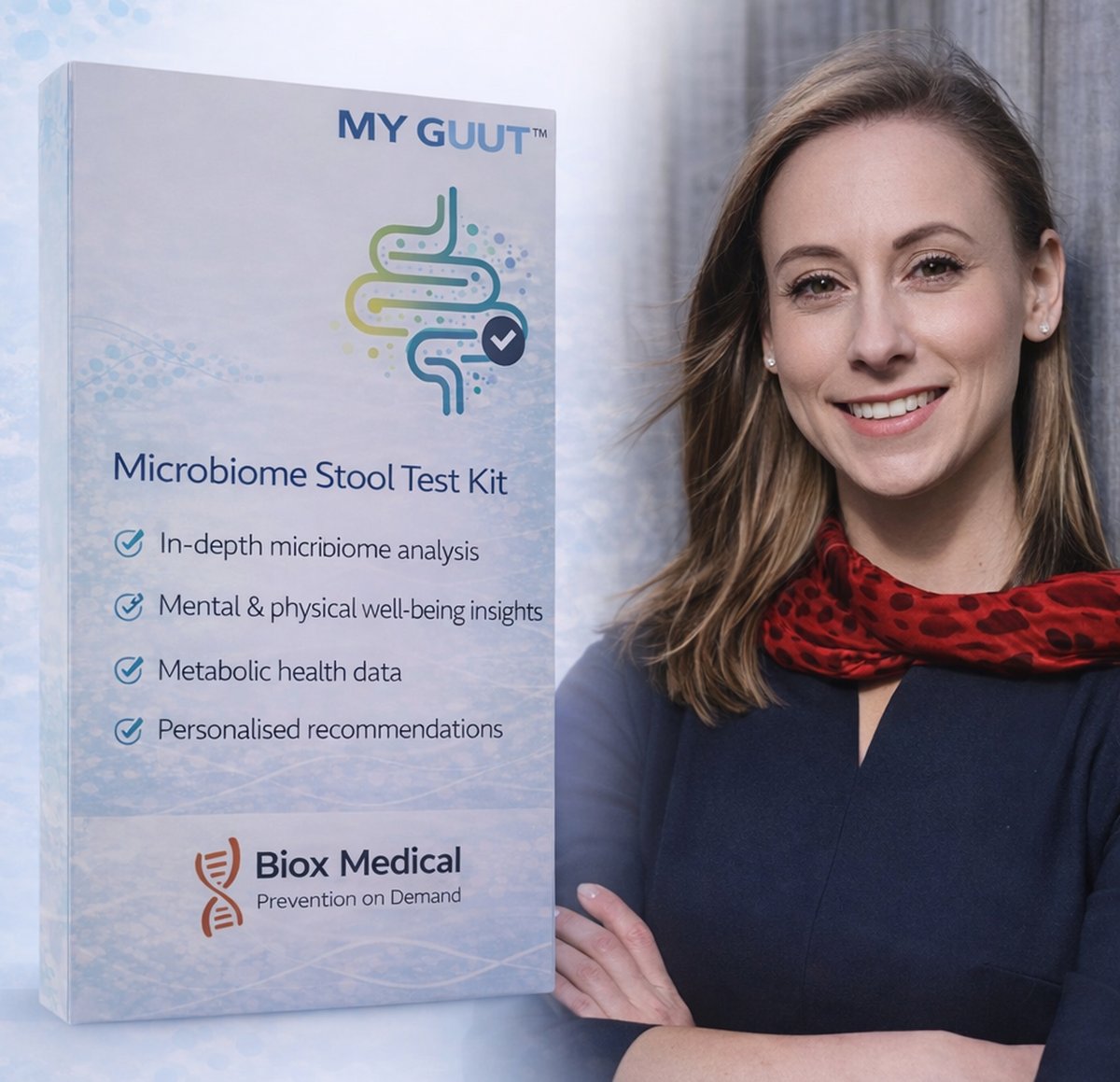
The MY GUUT kit, posted to you and returned free of charge.
What is actually measured
The laboratory extracts bacterial DNA from your sample and sequences it, identifying the species present and how common each one is. Everything in the report is derived from that single measurement: the composition of your gut bacteria on the day you collected.
The headline figures are microbial diversity, expressed as a Shannon index combining how many species you carry with how evenly they are spread, and a dysbiosis index summarising whether the balance leans toward beneficial or less helpful organisms. You also get your enterotype — whether your gut is dominated by Bacteroides, Prevotella or Ruminococcus, which tends to track long-term diet.
Then the detail: a Firmicutes to Bacteroidota ratio, and named lists of probiotic species, butyrate-producing species, mucin-producing species and sulphate-reducing species, each with your figure against a reference range. Over 70 genera in total.
Diversity is the headline number. A gut dominated by one or two species scores low; a gut carrying many species in similar proportions scores high. The report expresses this as a Shannon index combining richness and evenness.
The interpretive sections, and how to read them
Beyond the bacteria themselves, the report groups findings into gut-body interaction, gut health, wellbeing and metabolic health. These describe how your microbiome pattern compares with patterns seen in people with particular characteristics — energy, skin, sleep, digestion, weight regulation.
Read these as comparisons rather than findings about you. The laboratory is explicit about this: detecting an organism does not imply disease, and not detecting one does not rule it out. The comparisons are generated by machine-learning models trained on population data, and the summary recommendations are AI-assisted. That is not a criticism — it is how modern microbiome analysis works — but it does mean a heading saying you have a high tendency to something is a statement about statistical similarity, not a diagnosis.
If a section flags something and you have symptoms that go with it, see your GP. If a section flags something and you feel well, treat it as information about your diet rather than news about your health.
The recommendations
The last part of the report is practical: what to eat more of, what to cut back, and specific suggestions built around your own profile, including recipes. Most of it is unglamorous and well evidenced — more plant variety, more fibre, more fermented food, less ultra-processed food, less added sugar. If you follow it and retest, you can see what moved.
A wellness test about diet and digestion, not a diagnostic one.Most people who order it are curious rather than unwell, and want a baseline to work from.
Who it suits
People who are curious about their own biology and want detail rather than a wellness score. People changing their diet who want a before and after. People who have read about the microbiome and want to see their own.
It is a wellness test, not a medical one. It will not diagnose coeliac disease, inflammatory bowel disease, an infection or anything else, and it is not the right first step if you have persistent digestive symptoms — that needs a GP, who can arrange the tests that do diagnose.
The MY GUUT kitCollection materialsEverything included
What you get
Sample
Stool, collected at home
Method
Next-generation DNA sequencing of bacterial 16S rRNA
No. It is a wellness test. It does not diagnose disease, and the laboratory states plainly that detecting an organism does not imply the presence of disease and that not detecting one does not rule it out. If you have digestive symptoms, see your GP.
My report says high tendency to something. Should I worry?
Not on its own. Those sections compare your bacterial pattern with patterns seen in groups of people with particular characteristics. They are similarity scores, not diagnoses. If you have symptoms that fit, take the report to your GP and discuss it. If you feel well, treat it as information about diet.
Can it tell me if I have IBS or coeliac disease?
No. Those diagnoses need clinical assessment and, for coeliac disease, specific blood tests and usually a biopsy. A microbiome report cannot substitute for either.
How soon would a change show up?
Gut bacteria respond to diet within days, but a meaningful, settled change takes longer. If you are retesting to see the effect of a dietary change, leave at least three months.
When should I post my sample?
The same day you collect, Monday to Thursday. Not before a weekend or bank holiday. A sample held in the postal system degrades and may not be analysable.
Find out what is actually living in your gut.
£299 including free delivery and return. A 28-page report in about two weeks.