Real example reports for each of our tests, issued by the laboratories with personal details removed. Each one is explained in plain English, so you know what you would receive before you order.
This example is an abnormal result. The report has two pages.
Page one: the results
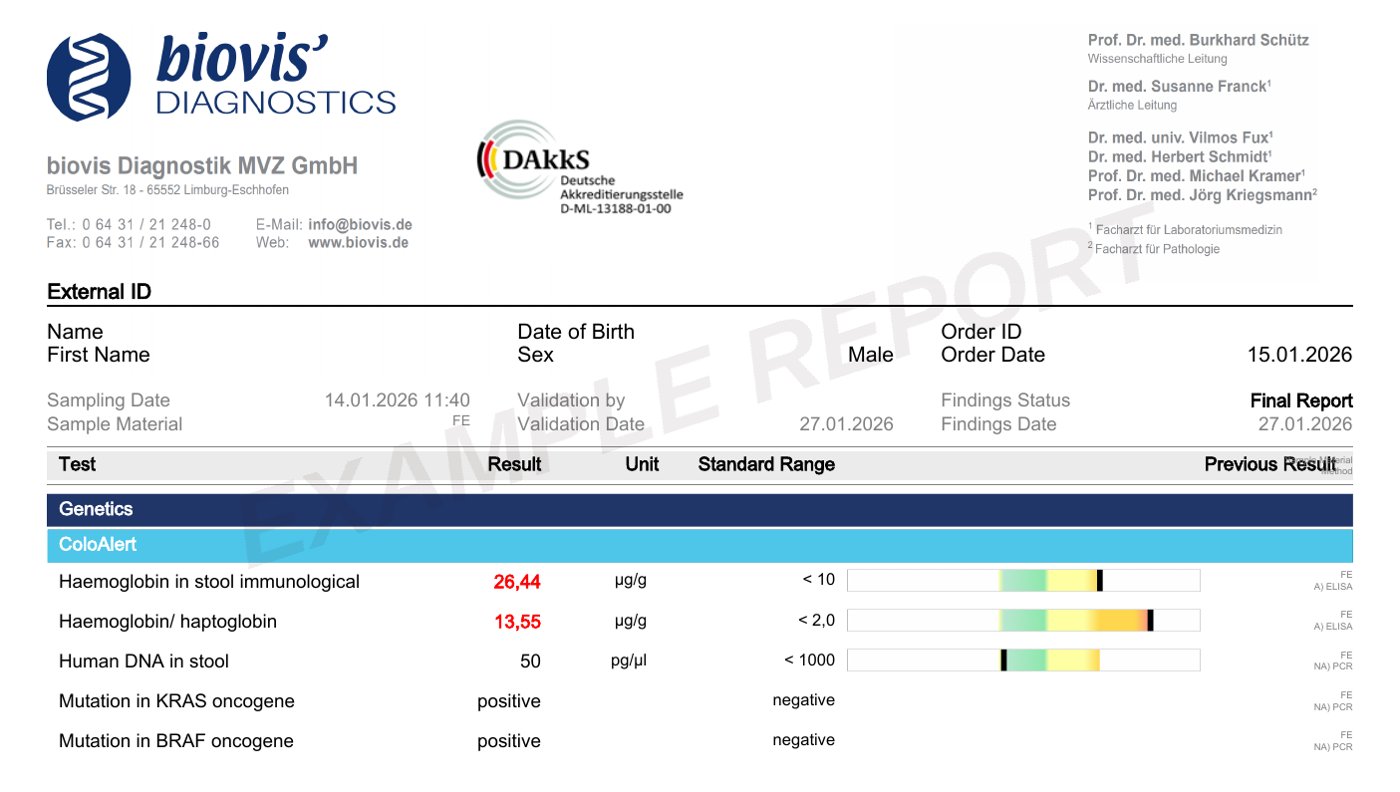
The first page lists the five markers measured from your stool sample, each with its result, the laboratory’s reference range and a coloured bar showing where the result falls. Results outside the range are printed in red.
Example report from biovis Diagnostik MVZ GmbH. Personal details removed.
Reading it line by line
Marker
In this example
What it means
Haemoglobin in stool
26.44 µg/g above <10
Hidden blood in the stool, the same thing the NHS FIT test looks for.
Haemoglobin–haptoglobin
13.55 µg/g above <2.0
A more stable form of blood that survives the journey through the bowel, so bleeding from higher up is less likely to be missed.
Human DNA in stool
50 pg/µl within <1000
The amount of DNA shed by the bowel lining. It rises when cells are shed abnormally fast.
KRAS mutation
positive
A gene change often found in bowel tumours and some polyps, carried into the stool by shed cells whether or not they bleed.
BRAF mutation
positive
Another tumour-associated gene change, detected the same way.
In this example, four of the five markers are abnormal. A single abnormal marker is enough for the result to need following up.
The small print on the right
Each line ends with the sample type and the method. FE means stool. ELISA and PCR are the laboratory techniques used. A) means the method falls within the laboratory’s ISO 15189 accreditation; NA) means it is performed by the same laboratory but sits outside the formal scope of that accreditation.
What a normal result looks like
The same layout, with every value inside its reference range, nothing printed in red, and both KRAS and BRAF reported as negative. A normal result is reassuring but not a guarantee, so keep taking part in NHS screening when invited, repeat ColoAlert every three years, and see your GP if you develop symptoms.
Page two: the laboratory’s comment
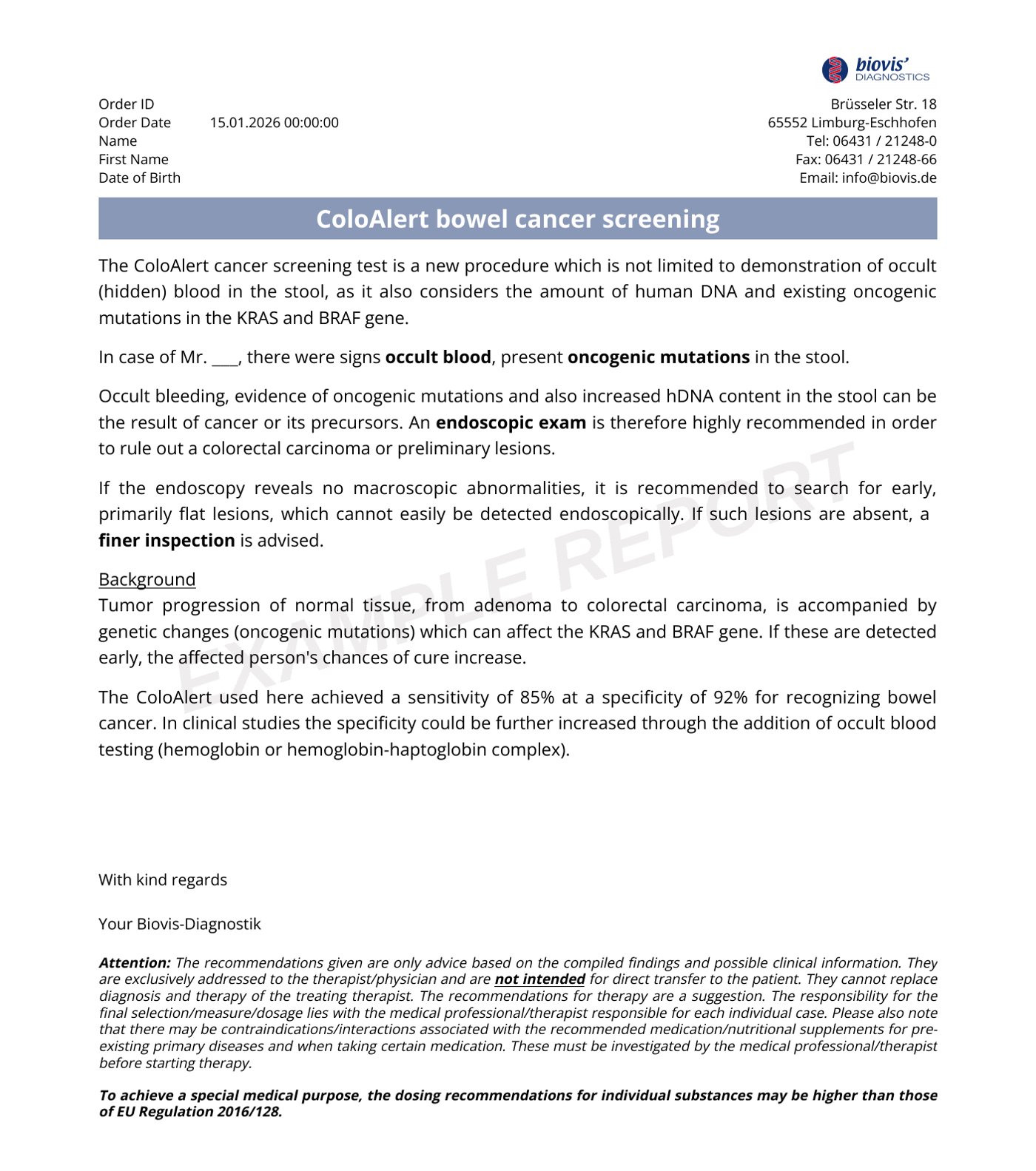
The second page is a written interpretation from the laboratory. When markers are abnormal, it says which ones and recommends an endoscopic examination, usually a colonoscopy, to look for cancer or the polyps that can come before it.
The laboratory’s interpretation, written for the clinician.
This page is written in clinical language and addressed to a doctor. That is the reason an abnormal ColoAlert result is never left with you alone: a GP reviews it through Northwest Health Ltd, a clinic registered with the Care Quality Commission, and contacts you to explain what it means and how to arrange a colonoscopy.
If your ColoAlert result looks like this
It is not a diagnosis of cancer. Most abnormal results turn out to be polyps, haemorrhoids or other causes, but each one needs a colonoscopy to find out.
You will hear from a GP. You do not need to chase us. The GP will talk the result through and give you written information to take to your own GP or to arrange a colonoscopy privately.
Do not repeat the test instead. A later normal result does not cancel out an abnormal one.
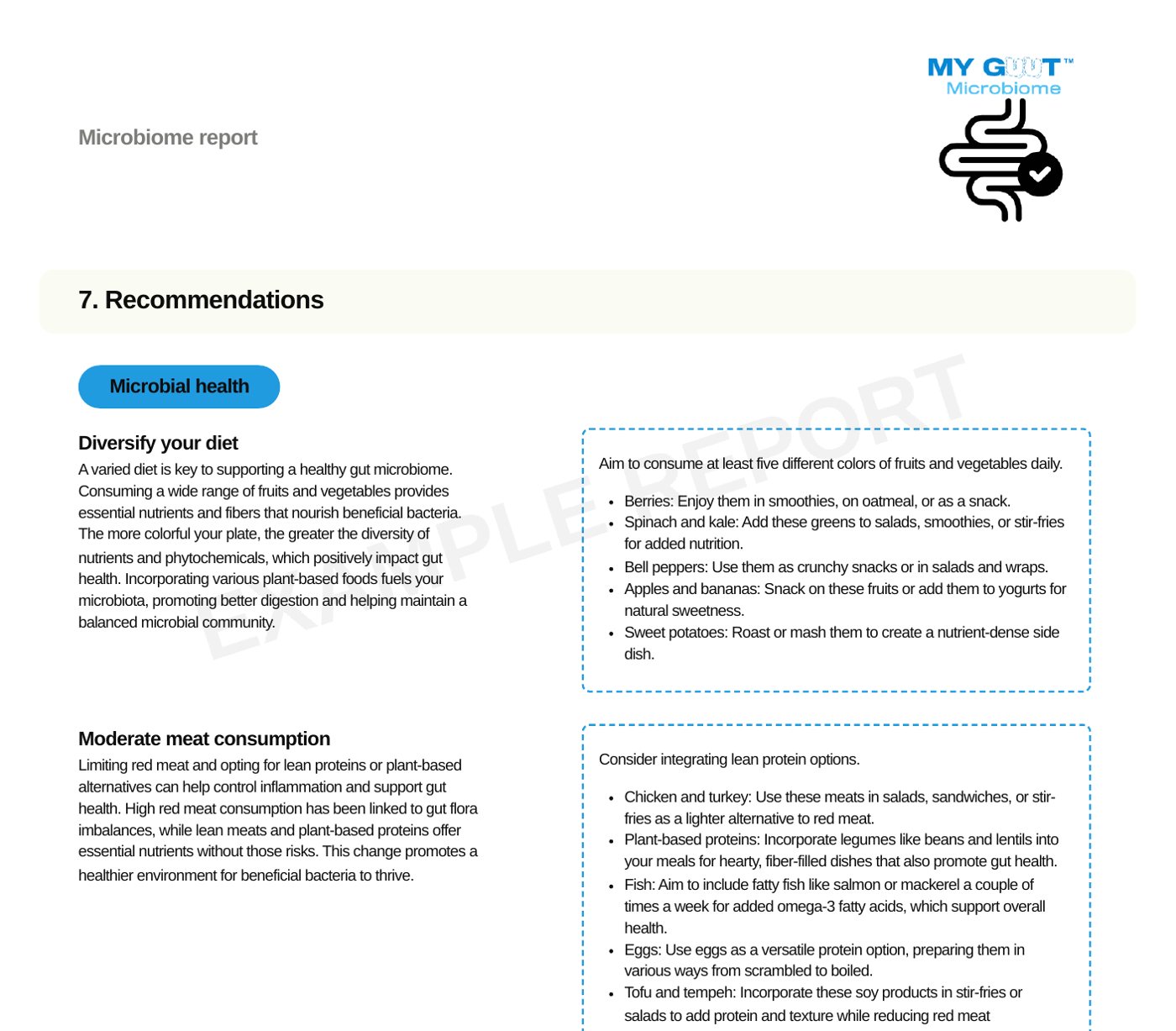
The MY GUUT report runs to 28 pages. It is built from one measurement: the bacterial DNA in your stool sample, sequenced to show which bacteria are present and in what proportions. Everything else in the report is derived from that.
Microbial health
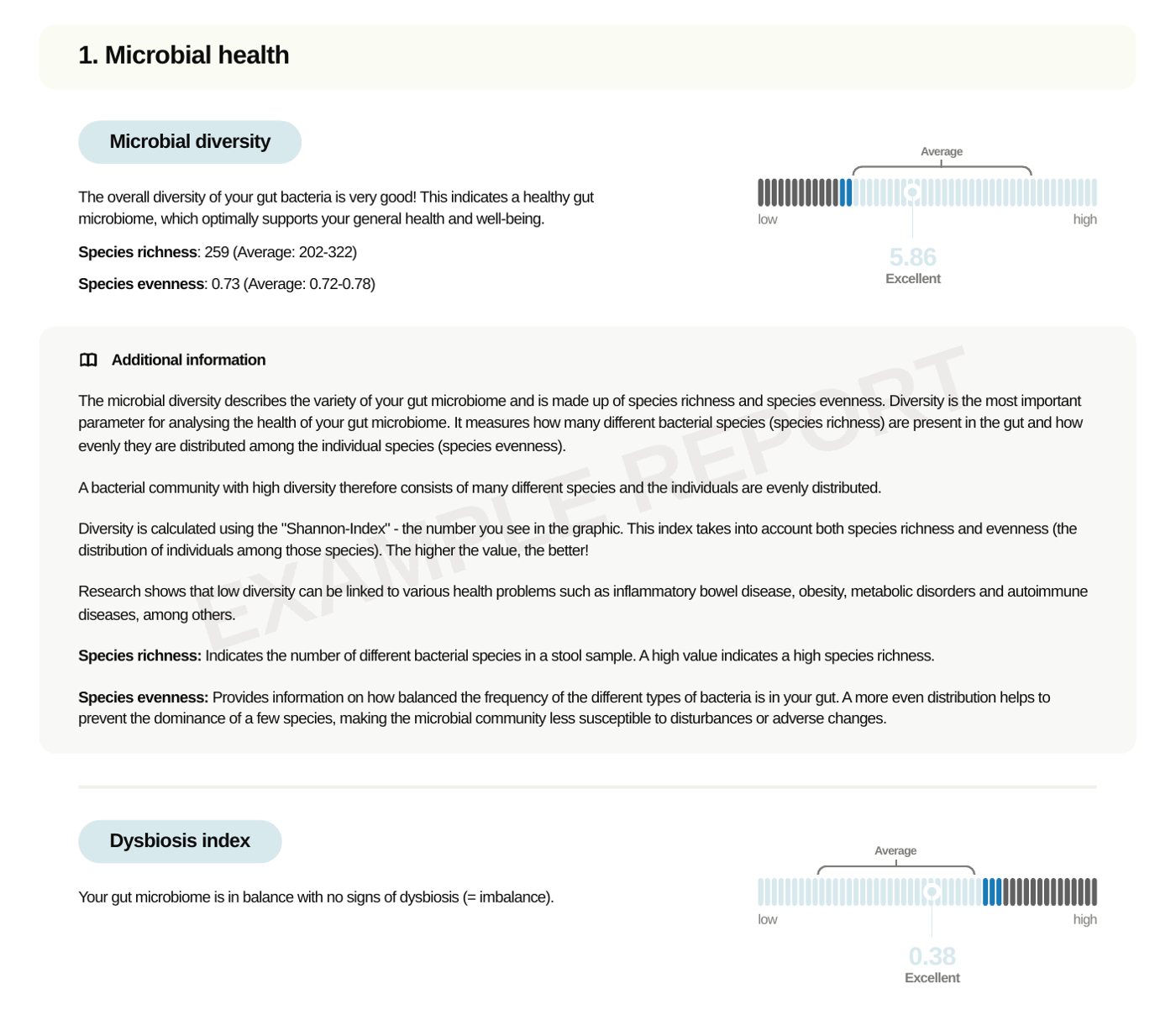
The report opens with the headline figures: how diverse your gut bacteria are (species richness and evenness, combined into a Shannon index), a dysbiosis index showing whether the balance looks disturbed, and your enterotype, the broad bacterial pattern your gut falls into.
Microbial health, from an example MY GUUT report. Personal details removed.
Gut–body interactions
Next come sections on how the bacteria present relate, in research studies, to areas such as the immune system, inflammation, skin, weight, mood, blood sugar and the thyroid. Each is given as a “tendency”.
Read these as comparisons, not findings about you. A tendency means your bacterial pattern resembles one seen more often in people with that trait in published studies. It does not mean you have the condition or will develop it. The laboratory states that detecting a microorganism does not imply disease, and not detecting one does not rule it out.
Your bacteria in detail
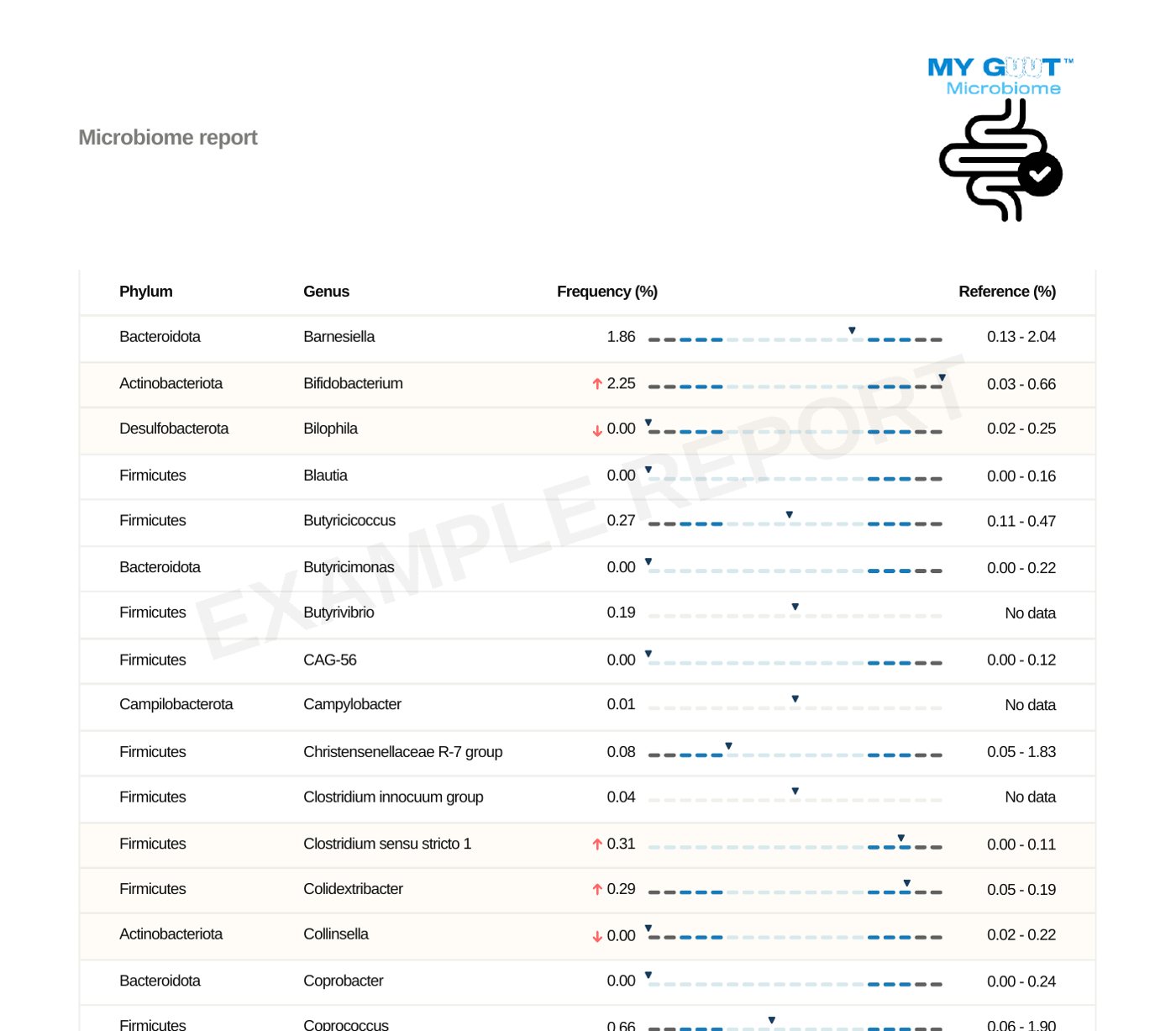
Over 70 bacterial groups are listed with your figure, a reference range and arrows marking anything above or below it.
Part of the bacteria table. Arrows mark results above or below the reference range.
Recommendations
The report ends with diet and lifestyle suggestions drawn from your own result, including recipes, followed by the research references behind each section.
Recommendations, tailored to the result.
MY GUUT is a wellness test. It cannot diagnose IBS, coeliac disease, inflammatory bowel disease or any other condition, and the report is not reviewed by a GP. If you have ongoing digestive symptoms, see your GP. More about MY GUUT.
Cellular ageing · wellness test
NAD Level Test
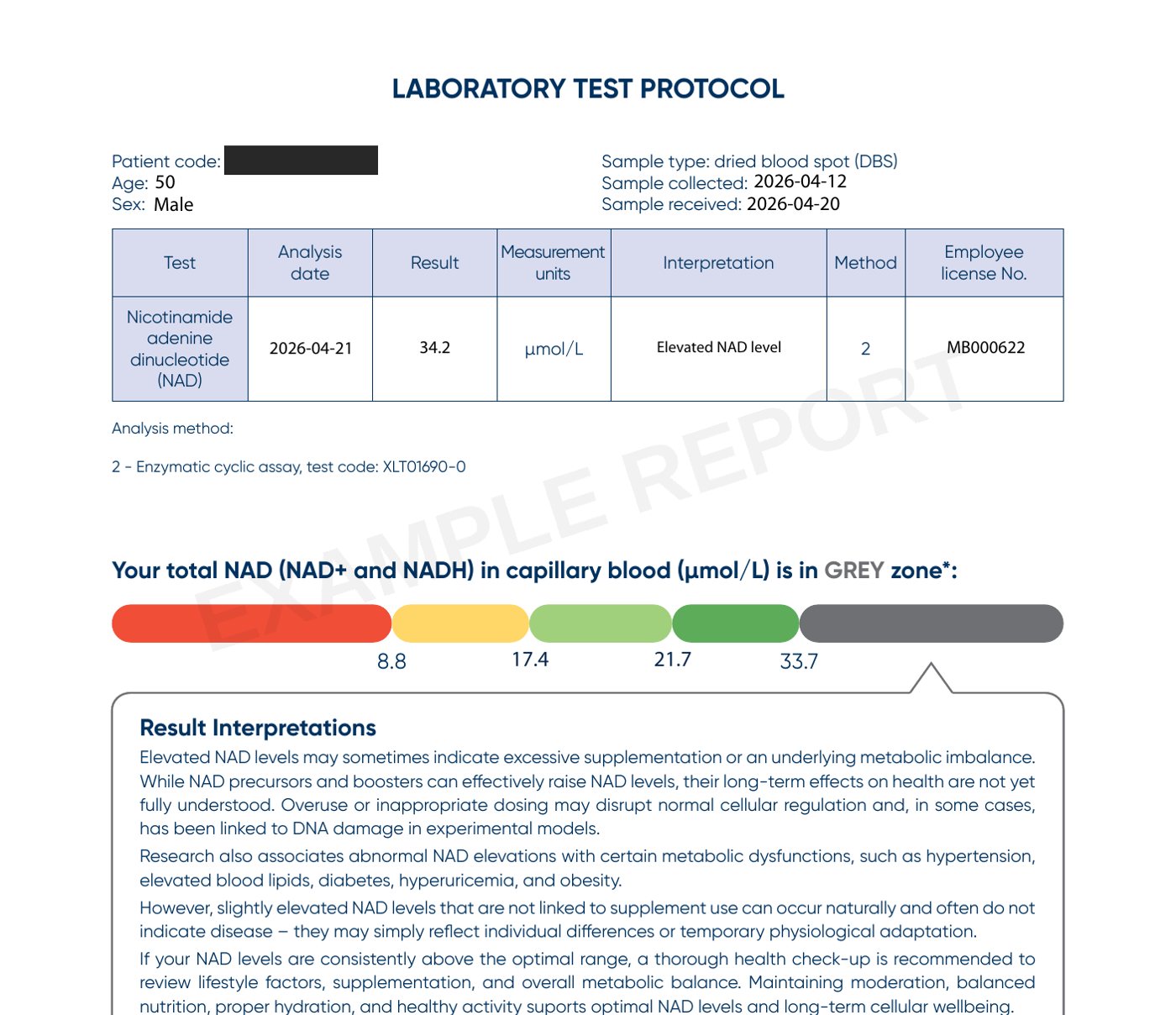
The NAD report comes from LifeLab1 in Vilnius, Lithuania. Page one gives your result; the remaining pages explain what NAD is and the research behind it.
Page one of an example NAD report. Personal details removed.
Reading it
One figure. Total NAD (NAD⁺ and NADH together) in capillary blood, in micromoles per litre. In this example it is 34.2.
Five coloured bands. The bar shows where the result falls, from red (low) through yellow and green to grey (elevated). The boundaries are set for your age and sex, from a study of 1,068 healthy people, so they will differ from this example.
An interpretation. This example is in the grey, elevated zone. The laboratory notes that this often reflects heavy supplementation, can occur naturally, and is worth a general health check if it stays high.
The NAD Level Test is a wellness test. There is no agreed clinical threshold at which a NAD level means you should act, and the report is not reviewed by a GP. It is most useful as a personal baseline, for example if you take NMN or NR. More about the NAD test.
Know what you are getting before you order.
Free UK delivery and prepaid return on every test.